Manipulated media known as deepfakes involves replacing a person's likeness, either in an image or video, through the use of Artificial Intelligence and deep learning algorithms. Despite being challenging to identify, experts note the presence of certain tell-tale signs.
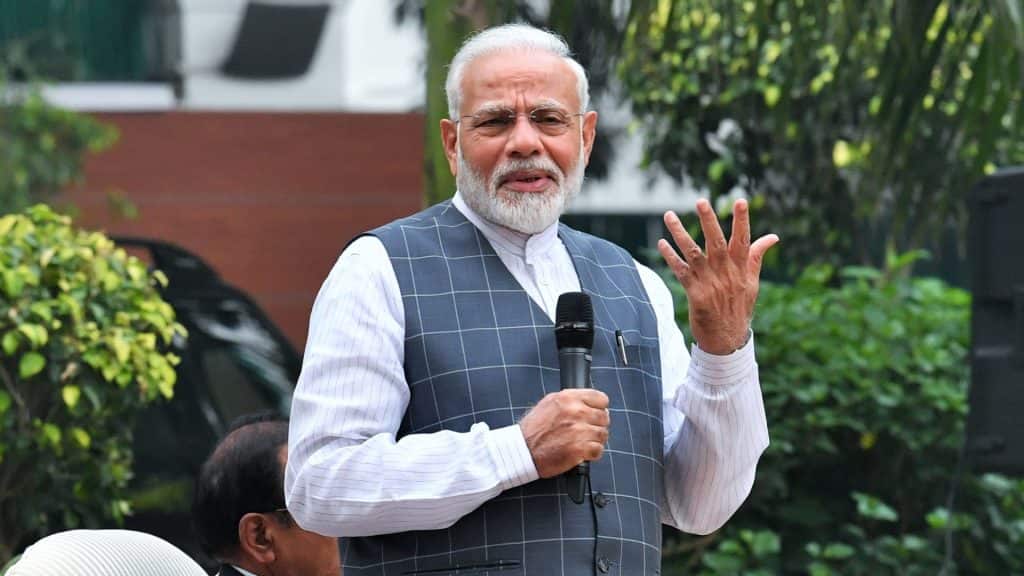
Prime Minister Narendra Modi has raised concerns about deepfakes. During the BJP's 'Diwali Milan' event at the party's headquarters in Delhi, he mentioned having come across a deepfake video of himself singing at a garba festival.
In light of the escalating threat posed by deepfakes generated through artificial intelligence, a critical concern has emerged, as articulated by the prime minister. A significant segment of society lacks a corresponding verification system to counter this growing menace.
Prime Minister Modi's observations coincide with the widespread dissemination of deepfake content featuring public figures such as Rashmika Mandanna, Katrina Kaif, and Kajol across various social media platforms.
In response to the escalating issue, the government recently issued an advisory to prominent social media entities, urging them to proactively identify instances of misinformation, deepfakes, and other content contravening established guidelines. The directive stipulates the removal of such content within a timeframe of 36 hours following its reporting.
However, a fundamental question arises: What exactly constitutes a deepfake, and how can one effectively discern its presence?
What are deepfakes?
Enter the realm of deepfakes, a captivating form of manipulated media where the very essence of a person – captured in an image or a video – undergoes a mesmerizing transformation into someone entirely different.
According to The Guardian, these creations represent the contemporary equivalent of the timeless art of photoshopping, a testament to the evolution of visual manipulation in the digital age.
The wizardry behind deepfakes lies in the realm of Artificial Intelligence, where intricate deep learning algorithms weave the tapestry of illusion, as eloquently articulated by the Indian Express.
They are generated by inputting a set of instructions, or algorithm, into a computer, accompanied by an extensive collection of images and audio recordings featuring a specific individual.
The computer program undergoes a learning process, assimilating the individual's facial expressions, mannerisms, voice, and intonations with remarkable precision.
Given a sufficient quantity of video and audio content featuring the target individual, it becomes possible to seamlessly merge fabricated video footage with manipulated audio, allowing for the manipulation of the individual's portrayed actions and statements.
Notably, the creation of most deepfakes necessitates the computing power beyond the capabilities of standard personal computers or laptops. According to The Guardian, the production of deepfakes typically occurs on sophisticated systems featuring high-end PCs equipped with powerful graphics cards or through the utilization of cloud computing resources.
The inception of deepfakes traces back to 2017, marked by a Reddit user overlaying the faces of celebrities such as Scarlett Johansson, Gal Gadot, and Taylor Swift onto adult film actresses.
While criminal entities exploit deepfakes for fraudulent activities, such as deceiving individuals out of their earnings, they are also employed maliciously to target and harass women through the dissemination of manipulated content, including revenge porn.
In the United States, instances of deepfakes have gained notoriety, with fabricated videos featuring figures like Hillary Clinton and Joe Biden endorsing Republican Ron DeSantis and engaging in derogatory behavior towards a transgender individual, respectively. These deepfakes have proliferated on social media, further blurring the lines between reality and fiction in the already polarized landscape of U.S. politics.
How to spot it?
Despite the endeavors of prominent social media platforms like Facebook, Twitter, and YouTube to proscribe and eliminate deepfakes, the efficacy of their content moderation remains inconsistent.
According to experts, identifying deepfakes poses a significant challenge.
Nevertheless, MIT provides explicit guidance on recognizing such fabricated content, highlighting a few distinctive indicators, including:
According to information from the Indian Express, online AI detection tools can also be employed for verification purposes.
Moreover, maintaining an awareness of current events is crucial, and it is advised not to share a video clip unless its legitimacy is unequivocally confirmed.
A prevalent scam involves receiving a video or audio call purportedly from a friend or loved one in urgent need of financial assistance. In a reported incident, a former Coal India employee suffered a financial loss of Rs 40,000 after responding to such a call.
According to ZDNet, experts recommend a simple yet effective method for verifying the authenticity of such callers: requesting them to turn their face to one side.
The website referenced the FBI, stating that incongruent sounds, such as a cough or sneeze, in relation to the events depicted in the video, can serve as a clear indication of manipulation.
Quoting Martin Anderson of Metaphysics.ai, the website highlighted a noteworthy observation: "That paucity of available data makes it difficult to obtain a range of profile images on non-celebrities that’s diverse and extensive enough to train a deepfake model to reproduce profile views convincingly."
Anderson further emphasized this vulnerability in deepfakes, suggesting a potential method for uncovering simulated correspondents in live video calls, a concern recently acknowledged as an emerging risk by the FBI. If suspicion arises regarding the authenticity of the person in a video call, individuals could employ a simple test by asking them to turn sideways for more than a brief moment, allowing for an assessment of the continued convincing nature of their appearance.
"New Crisis Coming"
Modi said in a diverse society like ours, deepfakes can cause a big crisis and even stoke the fire of disaffection in the society as people generally trust anything associated with the media in the same way anyone clad in “gedua” (saffron) tends to get respect from others.
“A new crisis is emerging due to deepfakes produced through artificial intelligence. There is a very big section of society which does not have a parallel verification system,” the prime minister told journalists at the programme where he aired views about a few things and sought their support to raise awareness.
The prime minister noted that earlier a movie with some controversial comments would come and go, but now it goes on to become a big issue. Even screening of such films becomes difficult on the ground that they have disrespected some section of society irrespective of the huge amount of money spent on making them, he noted.

Meity instructed social media companies to expeditiously take action against content infringing upon rules and regulations outlined in the IT Rules 2021. The directive specified the removal of such content within the stipulated timeframes and the disabling of access to such information or content, particularly in the case of deepfakes.
In instances of electronic impersonation, involving artificially morphed images, social media companies were advised to respond within 24 hours following the receipt of a complaint.
The advisory reminded intermediaries that any failure to act in accordance with the relevant provisions of the IT Act and Rules could trigger Rule 7 of the IT Rules, 2021. Such non-compliance may result in the organization losing the protections afforded by Section 79(1) of the Information Technology Act, 2000.




0 Comments